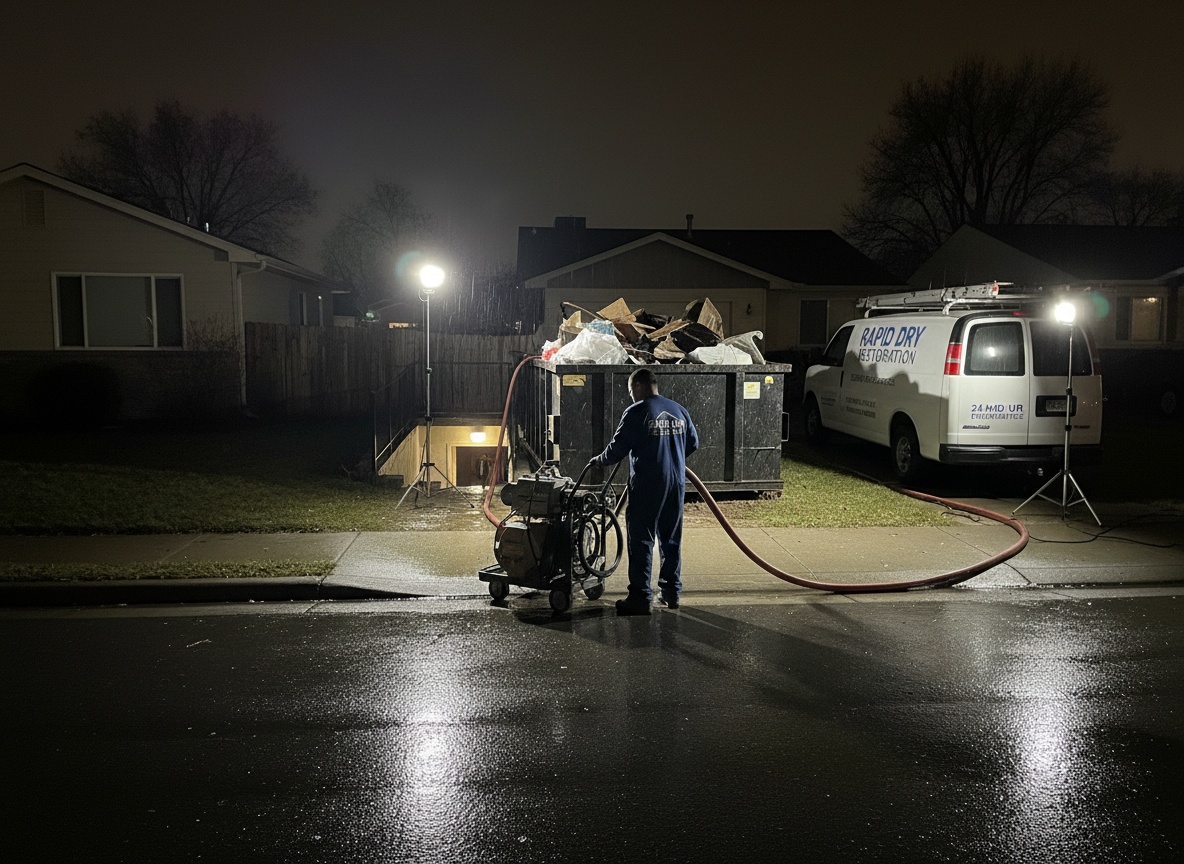
Midvale sits in Salt Lake County with a mix of older single-family homes in Old Town Midvale and newer builds near Bingham Junction TRAX Station. Cold winters often freeze supply lines in crawl spaces and garages, sending water across concrete slabs and into finished basements. Warm summer storms can overwhelm older storm drains along 7200 South, pushing groundwater into low-lying yards. These conditions require fast extraction before moisture migrates into drywall and subfloors common in 1960s-1980s stock.
Extraction crews must account for the semi-arid climate that hides slow leaks until they reach carpet or laminate. In neighborhoods like Bingham Junction, townhomes share walls, so water travels laterally into adjacent units before detection. Technicians cut and remove affected baseboard and insulation while documenting moisture readings to satisfy Salt Lake County permitting when structural repairs exceed cosmetic thresholds. Failure to address hidden saturation behind cabinets or under HVAC returns leads to repeated callbacks.
Portable desiccant dehumidifiers run longer here than in humid climates because ambient air holds less moisture, yet trapped water in slab cracks or under vinyl stays put. Homes near Midvale City Park often sit on clay-heavy soil that retains water after irrigation or snowmelt, increasing hydrostatic pressure on foundations. Crews place air movers at floor level and monitor relative humidity hourly to prevent secondary mold growth in these tight spaces.
Technician insight
In Midvale the thing that catches most people out with 24-hour water restoration near me is how fast water travels under the slab in Old Town Midvale homes built before 1980; once it hits the clay soil layer it moves sideways into the neighbor's foundation before anyone notices.
Winter Pipe Burst in Bingham Junction
A supply line froze under a 1970s ranch near the TRAX station and burst overnight. Water traveled under the slab into the finished basement and adjacent unit. Crews extracted standing water, placed drying equipment, and monitored readings for five days until levels stabilized. The homeowner avoided mold growth and returned to normal use without structural replacement.
How it works
- 1
Emergency Assessment
Technician arrives within the hour, locates the source, maps affected rooms, and records moisture levels in walls and floors.
- 2
Water Extraction
Industrial pumps and wands remove standing water from carpets, hardwood, and concrete while protecting unaffected areas.
- 3
Drying and Monitoring
Air movers and dehumidifiers are positioned; daily moisture checks continue until readings return to pre-loss levels.
- 4
Final Clearance
All equipment is removed, surfaces are sanitized, and a written report is provided for insurance or county records.
Pricing
Upfront written quotes provided after inspection; final cost depends on water volume, affected square footage, and drying duration.