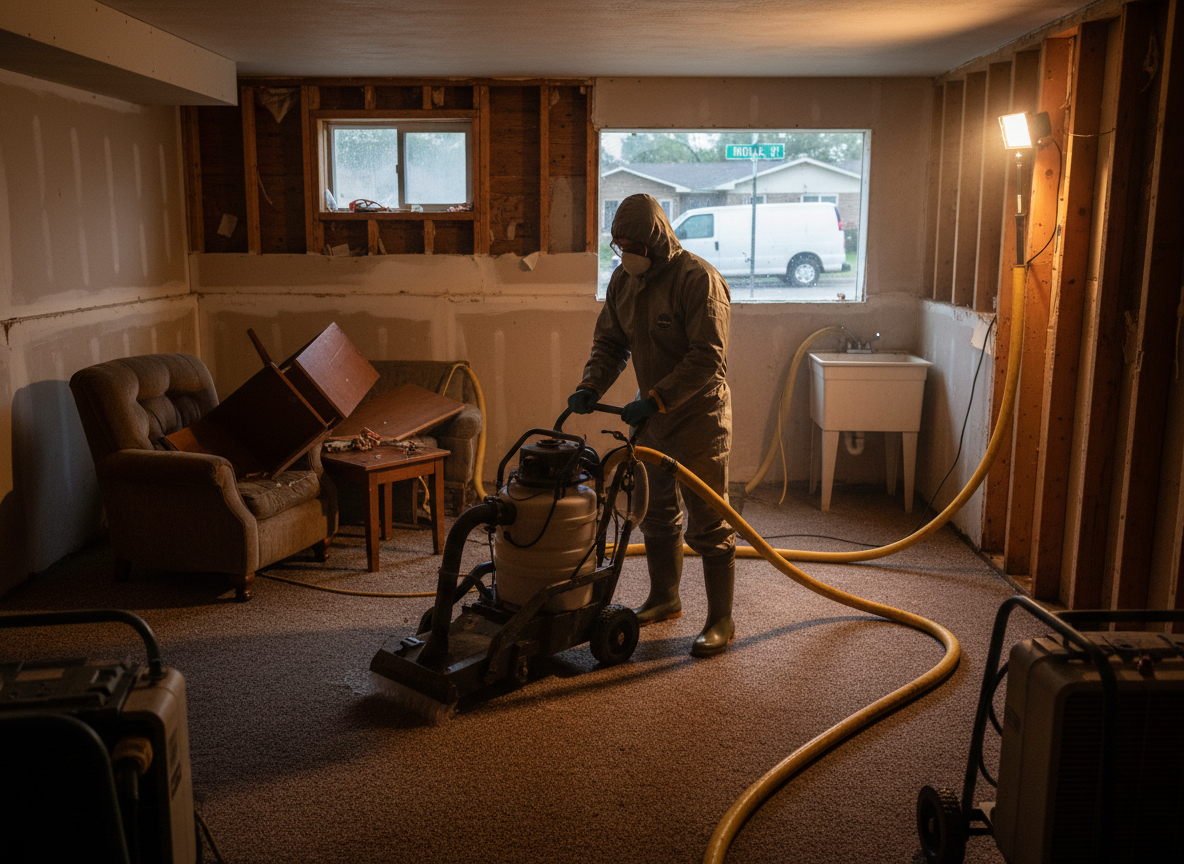
Midvale homes built before the 1980s in Old Town Midvale often have shallow foundations and limited perimeter drainage, so floodwater from spring snowmelt or sudden warm spells quickly saturates crawlspaces and slab edges. Semi-arid soils here hold fine sediment that stays damp longer once wetted, raising the risk of hidden mold growth behind baseboards or under vinyl flooring. Crews must pull carpet pads and insulation the same day to stay ahead of the rapid temperature swings between warm days and freezing nights common in Salt Lake County.
Water entering through window wells near Midvale City Park or along the Bingham Junction TRAX corridor frequently carries street debris and salts that corrode electrical boxes and furnace components. Extraction alone is not enough; dehumidifiers must run long enough to drop moisture content below 12 percent in framing lumber before drywall repairs begin. Homeowners in nearby Murray and West Jordan report the same issue when water backs up from shared storm drains during heavy summer thunderstorms.
Salt Lake County building codes require permits for any structural drying that affects load-bearing walls, so restoration plans include documentation of removed materials and moisture readings at each step. Ignoring these steps can delay insurance payouts or trigger reinspection fees. Solidground Network keeps equipment staged at 7505 Holden St so response times stay under two hours even on weekend nights.
Seasonal Flood Patterns
Spring thaw after cold winters is the most common trigger for basement flooding in Bingham Junction because frozen ground prevents natural absorption. Summer monsoon rains hit hardest in Old Town Midvale where older storm sewers overflow. Both seasons require different drying strategies to avoid trapped moisture in wall cavities.
Technician insight
In Midvale, the thing that catches most people out with Flood restoration services is how quickly snowmelt water refreezes inside wall cavities of pre-1980 homes in Old Town Midvale once the sun drops. You pull the baseboards and think it is dry, but the cold nights trap moisture against the foundation until spring turns to summer and mold shows up behind the new paint.
Spring Thaw Flood in Bingham Junction Basement
A single-story home near the Bingham Junction TRAX Station took in several inches of snowmelt water through an old window well. Inspection showed saturated insulation and floor joists with moisture readings above 20 percent. Extraction and targeted drying prevented mold spread into the adjacent living space; new subfloor sections were installed after county permit approval.
How it works
- 1
Emergency Assessment
Technician arrives within two hours, maps water depth, and identifies affected zones in crawlspaces or basements common to Midvale homes.
- 2
Water Extraction
Remove standing water and saturated materials using truck-mounted pumps suited for sediment-laden floodwater from local streets.
- 3
Drying and Monitoring
Place air movers and dehumidifiers, then track daily moisture readings until framing and subfloors reach safe levels.
- 4
Restoration and Repairs
Replace drywall, flooring, and trim while coordinating with Salt Lake County permit requirements before final walkthrough.
Pricing
Upfront written quotes after inspection; cost driven by water volume, affected square footage, and whether permits are required.