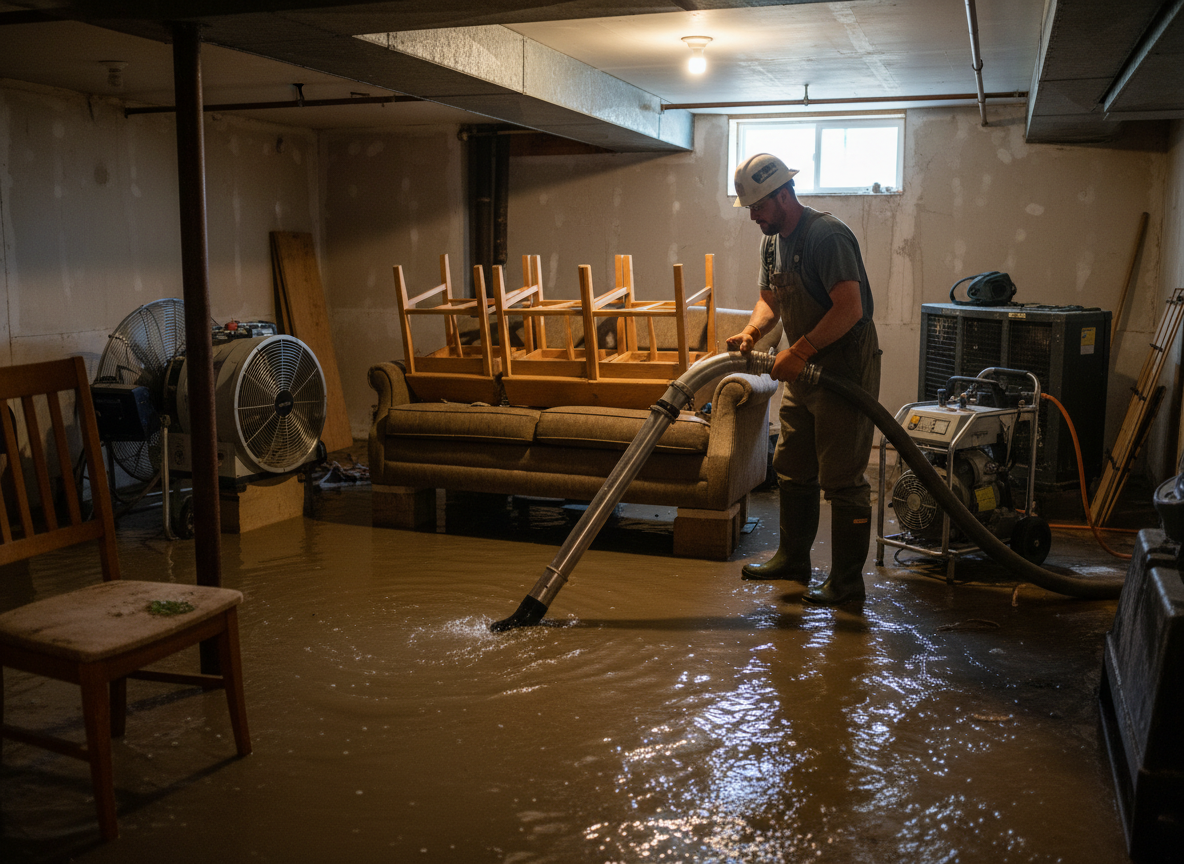
Winter temperatures in Midvale often drop below freezing, which stresses older plumbing in the single-story brick homes common in Old Town Midvale. When supply lines fail, water spreads quickly across slab foundations and into the clay-heavy soil that holds moisture for days. Emergency water removal crews must extract standing water within hours to prevent it from migrating toward footings and affecting neighboring properties along the TRAX corridor.
Summer monsoon rains can overwhelm downspouts and grading around homes in Bingham Junction, sending surface water into basements and crawl spaces. The semi-arid climate means many homeowners skip regular gutter maintenance, so a single heavy storm produces sudden interior flooding. Technicians use moisture meters on drywall and subflooring to map hidden saturation before removal begins, because residual dampness in the warm months quickly leads to microbial growth.
Water from a failed water heater or washing machine in a West Jordan or Murray rental can travel under shared walls into Midvale units. Crews coordinate with property managers to isolate units served by the same slab plumbing runs. Extraction equipment must be sized for the narrow hallways typical of 1970s duplexes near Midvale City Park so that furniture and belongings can be moved without blocking egress routes.
After extraction, crews document moisture levels at multiple depths in the floor assembly to satisfy Salt Lake County permitting requirements when structural repairs are later needed. Homes built before 1980 often have particleboard subfloors that delaminate once saturated, requiring targeted removal rather than whole-room tear-outs.
Technician insight
In Midvale, the thing that catches most people out with Emergency water removal is how fast water from a winter pipe burst travels under the slab and into the clay soil around Bingham Junction; once it reaches the TRAX tracks side of the street it can re-enter through foundation cracks days later if extraction stops too soon.
Burst supply line under 1970s Midvale duplex
A cold snap caused a copper line to split beneath the kitchen slab in an Old Town Midvale duplex. Water traveled under the shared wall into the neighboring unit and saturated both subfloors. We extracted water from both sides, placed drying equipment through the weekend, and returned daily to confirm moisture readings matched the dry side of the duplex before removing equipment.
How it works
- 1
On-site assessment
Technician arrives within the hour, locates the water source, and maps saturation using meters on walls, floors, and cabinets in the affected Midvale property.
- 2
Water extraction
Truck-mounted and portable pumps remove standing water from slabs and crawl spaces while protecting electrical outlets and finished surfaces.
- 3
Drying and monitoring
Air movers and dehumidifiers are placed; moisture readings are logged daily until levels match unaffected areas in the same neighborhood.
- 4
Final walkthrough
Homeowner inspects all treated rooms and receives a written moisture report for insurance or county records.
Pricing
Upfront written quote after inspection; final price depends on water volume, affected square footage, and number of days drying equipment must run.