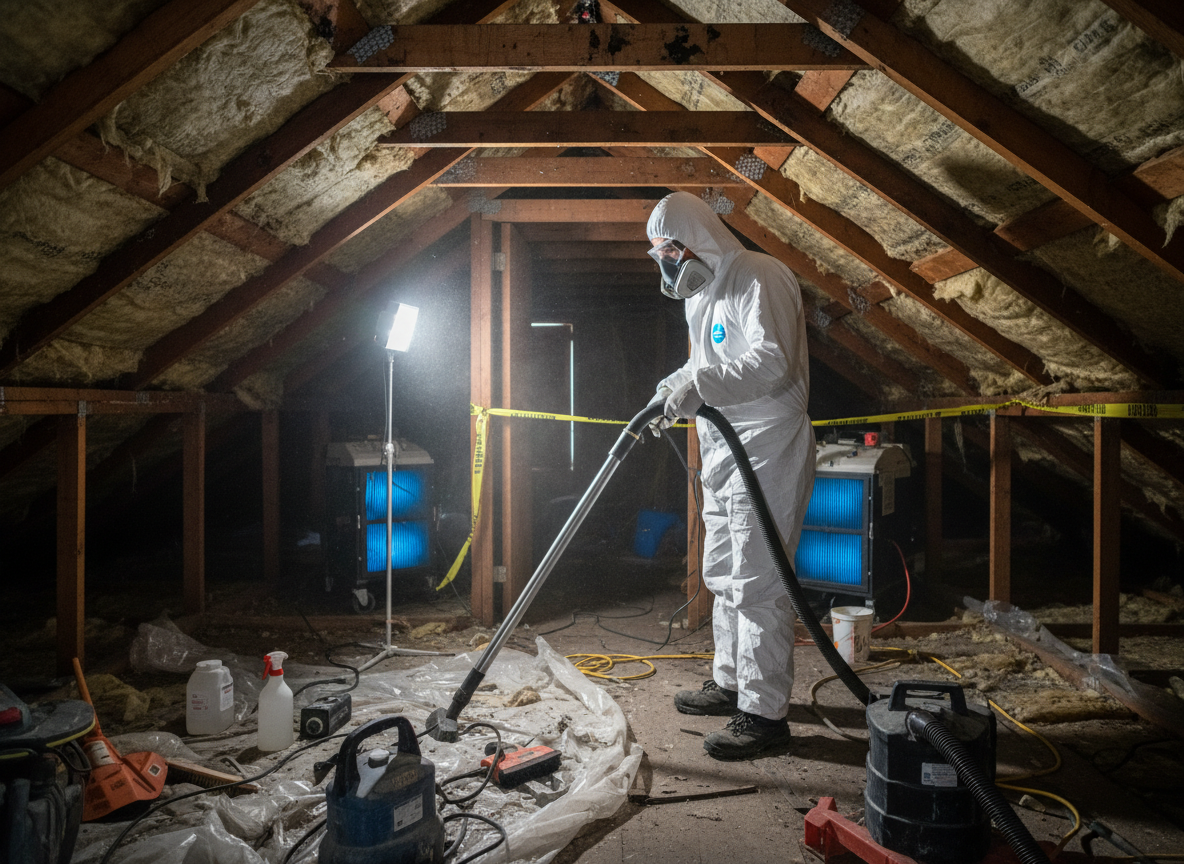
Midvale sits in Salt Lake County with a semi-arid climate that still brings cold winters capable of driving condensation into poorly ventilated attics. Homes in Old Town Midvale and around Bingham Junction TRAX Station often date to earlier decades with single-layer insulation and limited soffit or ridge venting. When warm interior air meets cold roof decking, moisture collects on rafters and sheathing, feeding mold that stays invisible until water damage from ice dams or summer monsoon leaks appears in ceilings.
Remediation here requires cutting access holes through drywall or removing insulation batts without disturbing active leaks near the Bingham Junction area. Technicians must map moisture with meters because the dry climate masks ongoing humidity pockets that return quickly once temperatures swing again. Containment becomes critical in two-story homes near Midvale City Park where spores can drift into living spaces through shared ductwork or open stairwells.
After removal, crews focus on restoring airflow with targeted baffles and insulation upgrades that match the original roof pitch common in West Jordan and Murray border neighborhoods. Skipping this step leaves the same conditions that allowed mold to start, especially when summer heat drives warm air upward into the same attic spaces.
Local Housing Factors
Older Midvale stock often features knob-and-tube wiring and limited attic access that complicates full inspection. Crews routinely find mold extending along collar ties that standard visual checks miss.
Technician insight
In Midvale, the thing that catches most people out with attic mold remediation is how quickly cold winter nights create hidden condensation on the underside of the roof deck in Old Town homes; the dry summers hide the problem until it has already traveled along rafters into insulation that never gets checked.
Hidden Mold After Roof Leak Near Bingham Junction
A homeowner in Bingham Junction noticed ceiling stains after spring snowmelt. We found mold running along rafters where ice dam water had wicked under the felt. We removed the wet insulation, dried the sheathing, and added ridge venting so the attic would not re-condense the next winter.
How it works
- 1
Moisture Mapping
Use meters and infrared to locate every damp area in the attic without guessing.
- 2
Containment Setup
Seal the work zone from the rest of the house using plastic barriers and negative air.
- 3
Mold Removal
Physically remove affected insulation, sheathing, and drywall sections that cannot be saved.
- 4
Drying and Verification
Run dehumidifiers and air movers, then retest until readings meet dry standards.
- 5
Ventilation Correction
Add or adjust vents and baffles to stop the condensation cycle common in local winters.
Pricing
Cost depends on attic size, depth of mold spread, and how difficult access is through finished ceilings.