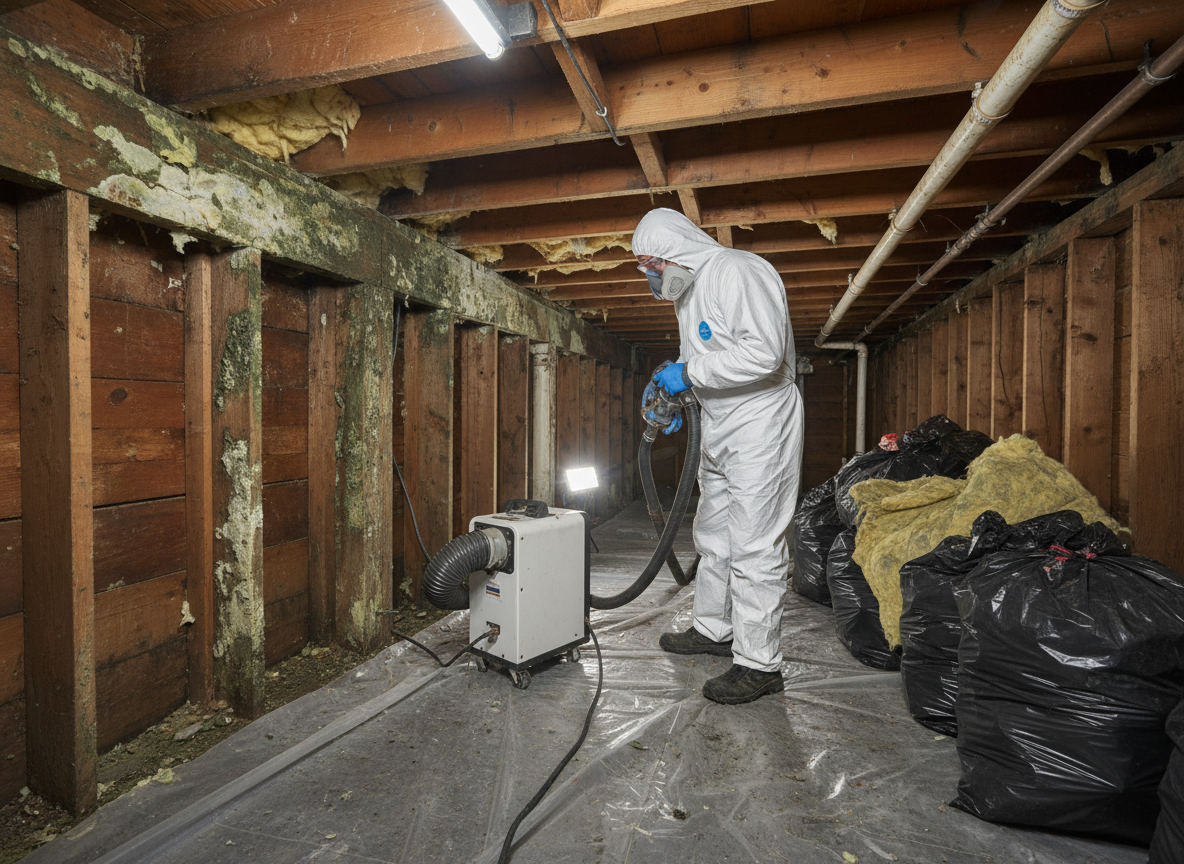
Midvale homes built before the 1980s in Old Town and around Bingham Junction TRAX Station often have vented crawl spaces with dirt floors and minimal insulation. Cold winter nights combined with warmer days create condensation on joists and subflooring that feeds mold growth. We start every job by mapping moisture sources from roof runoff near Midvale City Park or irrigation in West Jordan yards before any removal begins.
Removal work here requires separating living space from the crawl space with sealed poly sheeting to keep spores out of the home. We use negative air machines tied to exterior exhaust because the semi-arid climate still allows rapid spore spread when disturbed. In older stock we frequently find mold on kraft-faced insulation and rim joists where previous water events from frozen pipes went unnoticed.
After physical removal we apply EPA-registered antimicrobials only on non-porous surfaces and replace affected insulation with closed-cell options suited to Salt Lake County temperature swings. Homeowners in Murray often request post-work blower door testing to confirm the crawl space is no longer pulling conditioned air downward.
We document every step with photos and moisture readings because insurance adjusters in the county want clear proof the mold source was corrected rather than just treated.
Technician insight
In Midvale, the thing that catches most people out with crawl space mold removal is the combination of cold winters and older vented crawl spaces in Old Town homes. Homeowners seal the vents thinking it will stop cold air, but that traps moisture from the ground and turns the space into a mold factory. We always check how close the house sits to the water table near Bingham Junction before deciding on vapor barrier upgrades.
Old Town Midvale Crawl Space After Pipe Leak
A homeowner near Midvale City Park called after noticing musty air in the kitchen. We found standing water from a frozen supply line that had soaked the dirt floor and rim joists for weeks. After mapping moisture and setting containment we removed saturated insulation, dried the space, and installed a sealed vapor barrier. The home passed final moisture checks and the musty smell disappeared.
How it works
- 1
Inspection and Moisture Mapping
We enter the crawl space from the exterior access in Midvale homes and record relative humidity, wood moisture content, and visible growth locations while noting any standing water from seasonal snowmelt.
- 2
Containment Setup
Plastic sheeting and negative air machines isolate the crawl space from the living area to prevent spore migration into Old Town Midvale residences.
- 3
Removal and Cleaning
We remove affected insulation and loose debris, HEPA vacuum surfaces, and wipe down exposed wood and pipes before applying antimicrobial treatment where appropriate.
- 4
Drying and Verification
Dehumidifiers and air movers run until wood moisture readings drop below 12 percent, followed by a final inspection and report for the homeowner.
Pricing
Cost depends on crawl space size, depth of mold, and whether insulation replacement or minor structural drying is required; we provide upfront written quotes after inspection.