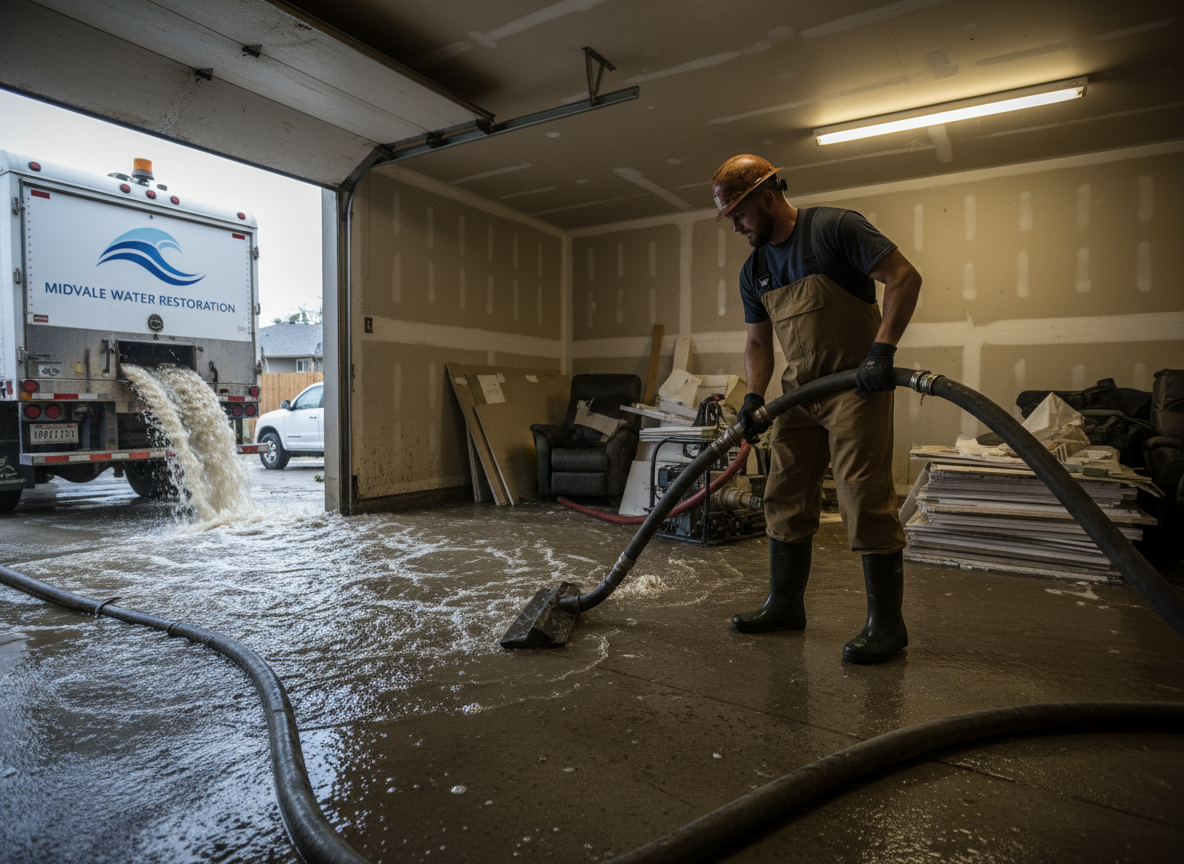
Water extraction in Midvale requires fast removal of standing water before it migrates into the slab or crawl spaces common in 1960s-1980s homes around Old Town Midvale and Bingham Junction. Cold winter temperatures often cause supply line failures while semi-arid summers bring sudden thunderstorms that overwhelm older storm drains near the Bingham Junction TRAX Station. Industrial extraction units with submersible pumps pull water from concrete surfaces and carpet padding before moisture readings guide the drying phase. Failure to reach trapped water under flooring leads to hidden damage that later affects neighboring units in multi-family buildings common in the area.
Salt Lake County soil tends to hold moisture longer after extraction, especially in the low-lying sections near Midvale City Park where water tables rise during spring runoff. Technicians use moisture meters and infrared cameras to locate residual water behind baseboards and in wall cavities without unnecessary demolition. Properties in nearby Murray and West Jordan share similar construction, but Midvale's mix of older single-family homes demands slower, methodical extraction to avoid pushing water into shared walls. Skipping this step frequently results in recurring musty odors that homeowners notice months after the initial event.
Extraction jobs here often involve coordination with local utility shutoffs at the meter when main lines break, a step that protects both the home and the surrounding street infrastructure. Crews document water depth and affected square footage for insurance adjusters while keeping extraction equipment noise low during overnight calls in residential neighborhoods. Warm summer days accelerate evaporation once water is removed, but the same heat can cause rapid mold growth if drying is incomplete, particularly in the compact layouts found throughout Bingham Junction.
Technician insight
In Midvale, the thing that catches most people out with water extraction is how quickly winter pipe bursts in Old Town Midvale homes send water under the slab toward the foundation footings, where it hides from standard pumps and later wicks back up through the floor.
Crawl Space Extraction After Winter Line Break
A supply line failed during a cold snap in a Bingham Junction home, sending water across the dirt floor. We located pooled water extending toward the front foundation wall and used portable extractors to clear it without disturbing utilities. Air movers were then staged to dry the soil and joists over three days.
How it works
- 1
On-Site Assessment
Technician arrives at the Midvale address, identifies water source, and maps affected zones in the home.
- 2
Water Removal
Industrial pumps and vacuums extract standing water from floors, carpets, and low areas.
- 3
Moisture Verification
Readings confirm remaining moisture levels in walls, subfloors, and soil-adjacent spaces.
- 4
Equipment Setup
Air movers and dehumidifiers are positioned for controlled drying before final walkthrough.
Pricing
Upfront quotes provided after inspection; final cost depends on water volume, access, and drying duration.